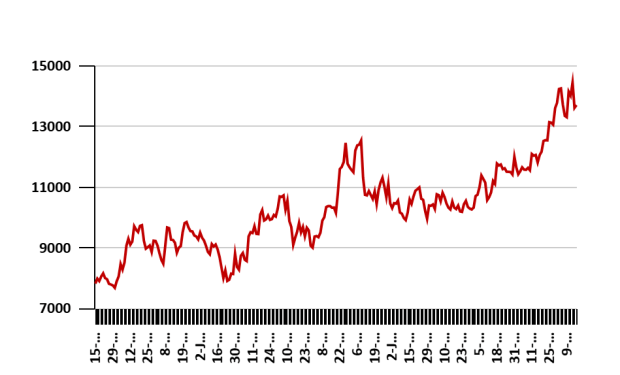
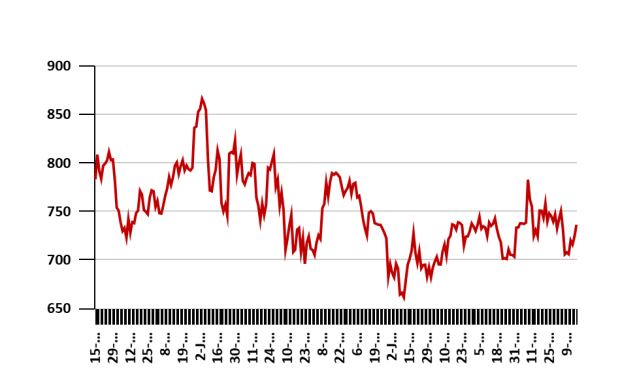
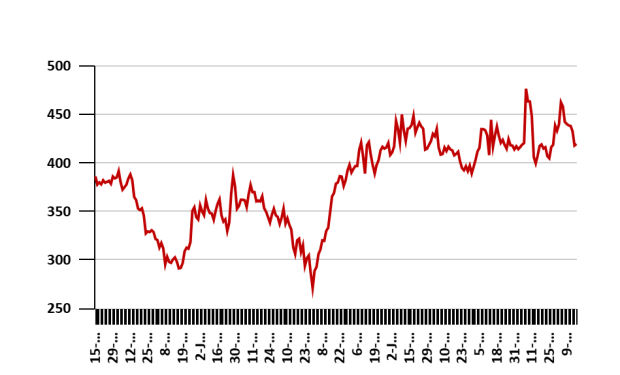
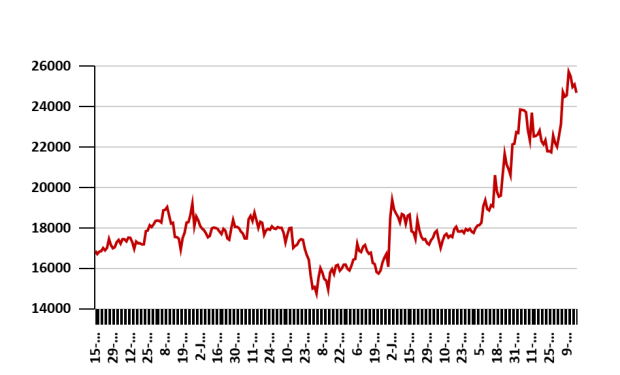
The Indian stock market ended the week of October 19-23, 2026, with sharp losses. The Sensex fell 2.15%, while the Nifty 50 declined 2.36%, as rising crude oil prices, foreign investor selling and mixed September-quarter earnings weighed on sentiment.
However, brokerage reports identified potential opportunities in 10 stocks, with indicated upside ranging from 22% to 91% based on their target prices.
The 10 stocks covered here have potential upside estimates ranging from 22% to 91%, based on the target prices cited in the reports.
1. Swiggy: Nuvama sees 91% upside potential
Nuvama has retained its ‘Buy’ rating on Swiggy, although it has lowered its target price from Rs 444 to Rs 403. The revised target still implies an upside of around 91% from the reference market price used in its report.
According to the brokerage report, Swiggy’s revenue increased 11.1% quarter-on-quarter to Rs 7,570 crore in the September quarter. However, losses widened, with earnings before interest, tax, depreciation and amortisation (EBITDA) loss reaching Rs 770 crore and net loss standing at Rs 920 crore.
Food delivery contribution margin improved to 7.7%, while Instamart’s contribution margin declined to minus 1%.
2. KEI Industries: Jefferies sees 59% upside potential
Jefferies has a ‘Buy’ rating on KEI Industries and a target price of Rs 6,150, implying an upside of nearly 59% from the reference market price.
According to the global investment bank report, demand for cables and power transmission infrastructure could support growth over the next two years. KEI’s capacity expansion at Sanand, Gujarat, has started commissioning in phases and is expected to contribute to future growth.
“This is a premium to the last 5- year avg of 36x P/E, as visibility on exports and power transmission is improving. Our EPS factors in 20% CAGR over FY26-29E,” it said.
3. Vishal Mega Mart: JM Financial sees 49% upside potential
JM Financial has maintained its ‘Buy’ rating on Vishal Mega Mart, with an unchanged target price of Rs 134. This indicates an upside potential of around 49% from the reference price used in its report.
The retailer’s September-quarter performance fell short of expectations. According to JM Financial, EBITDA was 8% below its estimate, while profit after tax missed expectations by 12%. Net profit rose 3.7% year-on-year to Rs 160 crore.
The timing of festivals affected demand during the quarter, with Navratri, Durga Puja and Dussehra shifting into the December quarter. Apparel sales grew 9.5%, compared with 18.2% growth in fast-moving consumer goods (FMCG).
4. Sobha: Motilal Oswal sees 45% upside potential
Motilal Oswal has retained its ‘Buy’ rating on Sobha and set a target price of Rs 1,710 per share. This represents an upside of around 45% from the reference market price.
According to the brokerage report, Sobha recorded pre-sales of Rs 2,210 crore in the September quarter, up 16% year-on-year. Bengaluru accounted for 60% of bookings, followed by the National Capital Region at 27%.
However, the company also reported lower revenue and profit. Motilal Oswal has highlighted a pipeline of 18 projects covering 20.4 million square feet, with a combined gross development value of Rs 31,400 crore.
5. Eternal: JM Financial sees 44.2% upside potential
JM Financial has a ‘Buy’ rating on Eternal and a 12-month target price of Rs 450, implying an upside potential of 44.2% from the reference market price.
The brokerage highlighted growth in both Blinkit’s quick-commerce business and Zomato’s food delivery operations. Blinkit’s net order value increased 79.3% year-on-year in the September quarter, while Zomato’s net order value grew 21.5%.
Blinkit’s adjusted EBITDA improved to Rs 1.84 billion, with its margin rising to 0.9% from 0.6% in the previous quarter. The company has also raised its store expansion targets.
6. Crompton Greaves Consumer Electricals: Jefferies sees 41% upside
Jefferies has retained its ‘Buy’ rating on Crompton Greaves Consumer Electricals, with a target price of Rs 305. The target implies an upside of around 41% from the reference market price.
According to the report, Crompton Greaves September-quarter profit after tax was in line with expectations, while sales grew 18% year-on-year and adjusted profit after tax rose 30%.
The company has increased prices in its electrical consumer durables segment to manage higher input costs.
7. Bajaj Finance: Nomura sees 32.7% upside potential
Nomura has maintained its ‘Buy’ rating on Bajaj Finance and set a target price of Rs 1,270, implying an upside potential of 32.7% from the reference market price.
Bajaj Finance September-quarter profit growth was in line with the brokerage’s estimate, and it raised its full-year loan growth guidance. Nomura expects lending growth to remain healthy, with newer businesses such as gold loans adding to the portfolio.
However, higher interest rates could put pressure on net interest margins, which measure the difference between interest earned and interest paid.
8. Oberoi Realty: JM Financial sees 32.1% upside potential
JM Financial has a ‘Buy’ recommendation on Oberoi Realty, with a target price of Rs 2,250. This implies a potential upside of 32.1% from the reference market price.
According to the brokerage report, the Oberoi Realty recorded quarterly pre-sales of Rs 9,150 crore, supported by the launch of Three Sixty North in Gurugram. The project contributed Rs 7,890 crore, with 97% of the launched area booked.
JM Financial expects new projects to support the sales pipeline.
9. ACME Solar Holdings: Nomura sees 26% upside potential
Nomura has initiated coverage on ACME Solar Holdings with a ‘Buy’ rating and a target price of Rs 505, indicating an upside of 26% from the reference market price.
According to the brokerage report, the company is expected to add 4.3 gigawatts of contracted capacity over FY27-FY29. Nomura expects this expansion to support revenue and EBITDA growth over the period.
ACME Solar is also increasing its focus on firm and dispatchable renewable energy, which combines power generation with storage to meet specified delivery schedules.
10. CEAT: Nomura sees nearly 22% upside potential
Nomura has retained its ‘Buy’ rating on CEAT, although it reduced its target price by 6% to Rs 4,009 per share. The revised target implies an upside of nearly 22% from the reference market price.
The tyre maker’s September-quarter revenue was in line with Nomura’s projections, while its EBITDA margin exceeded expectations. However, the brokerage expects raw material prices to rise sequentially in the December quarter, putting pressure on costs.
“It has taken 12-13% price hikes so far in replacement and 14-15% in OE, and more hikes are planned in 3Q. Price hikes by competitors also have been similar with a lag,” Nomura said.
Overall, Swiggy, KEI Industries and Vishal Mega Mart feature among the stocks with the highest indicated upside, while the remaining picks span sectors such as real estate, consumer durables, financial services and renewable energy.
Article written by Olivia Kunjumon
Source: FinancialExpress
Disclaimer: This article is based on research reports from one or more brokerage firms and is for informational purposes only. The views, target prices, and recommendations expressed are those of the respective brokerage firms