

In a market that often chases growth and quick gains, dividend income tends to stay in the background. Yet, dividends play an important role in long-term investing. They provide regular cash flows to investors. More importantly, when these payouts are reinvested, they quietly add to compounding. Over time, this combination of income and reinvestment can meaningfully enhance overall returns.
Dividend-paying companies also reflect a certain financial discipline. These are businesses that generate surplus cash and choose to share it with shareholders. Instead of deploying all profits back into expansion, they return a portion consistently. This creates a steady income stream. It also offers some cushion during periods when price returns may be uncertain.
One such investor who appears to allocate capital through this lens is Radhakishan Damani. He is best known as the founder of DMart (Avenue Supermarts) and as a long-term investor in Indian equities. Over the years, his approach has been associated with patience, discipline and a strong focus on business fundamentals. While his core success comes from building a high growth retail business, DMart, his listed portfolio also reflects how capital is deployed across different types of companies.
This article builds on that idea. It focuses on a set of stocks in his portfolio that stand out for their dividend track record. The selection is not based on yield alone. It looks at consistency of payouts and the ability of these businesses to generate surplus cash over time. Together, these stocks help explain how dividend-paying companies fit into a broader capital allocation strategy.
#1 VST Industries: High-Growth Core and Efficiency Gains
VST Industries is engaged inter-alia in manufacture and trading of cigarettes, tobacco and tobacco products.
As of March 2026, Radhakishan Damani holds 29.1% stake of VST Industries. This is his shareholding pattern in VST Industries for the past eight quarters.
Radhakishan Damani Shareholding Pattern in VST Industries (June 2024 – March 2026)
| Jun-24 | Sep-24 | Dec-24 | Mar-25 | Jun-25 | Sep-25 | Dec-25 | Mar-26 |
| 34.7% | 29.1% | 29.1% | 29.1% | 29.1% | 29.1% | 29.1% | 29.1% |
Q3 FY26 Performance: Navigating Inflation with 120% Profit Growth
VST Industries reported a steady performance in the March quarter, supported by stable demand in the cigarette segment and a recovery in execution during the second half of the year. Revenue for Q3 FY26 stood at Rs 689 crore, up 51.4% year-on-year (YoY), reflecting strong growth in sales realisation and improved operating momentum. Net profit for the quarter came in at Rs 117 crore, up 120.8% YoY, translating into a robust year-on-year growth.
The performance comes despite a challenging operating environment. The company faced cost pressures due to inflation in key raw materials, particularly tobacco leaf, along with regulatory changes in taxation. However, focused cost management and strategic procurement helped offset some of these pressures. The cigarette portfolio also saw gradual traction in the mid-premium segment, aided by new product launches and brand interventions aimed at improving market positioning.
Efficiency & Dividends: The Impact of the Integrated Azamabad-Toopran Facility
On the operational front, VST has completed the integration of its Azamabad facility with the Toopran manufacturing unit. The integrated plant is now fully operational and is expected to improve efficiency, reduce costs and support long-term growth. The company has also been investing in digital initiatives across its distribution network and supply chain, aimed at strengthening reach and improving execution across markets.
Dividend remains a key highlight for the company.
For FY26, the board has recommended a final dividend of Rs 12 per share, with July 10, 2026 set as the record date. At the current price, the dividend yield is a very attractive 4.7%.
The company has declared 26 dividends since 2001, indicating a consistent track record of returning cash to shareholders.
The payout reflects a steady pattern of distribution in recent years. It is supported by strong cash generation and the relatively low capital intensity of the core business.
The overall positioning reflects a business that balances growth with shareholder returns. While the company is working to strengthen its presence in the mid-premium segment and improve operating efficiency, it continues to generate surplus cash. This allows it to maintain regular dividend payouts, making it a relevant example in portfolios where dividend income and reinvestment play a role alongside capital appreciation.
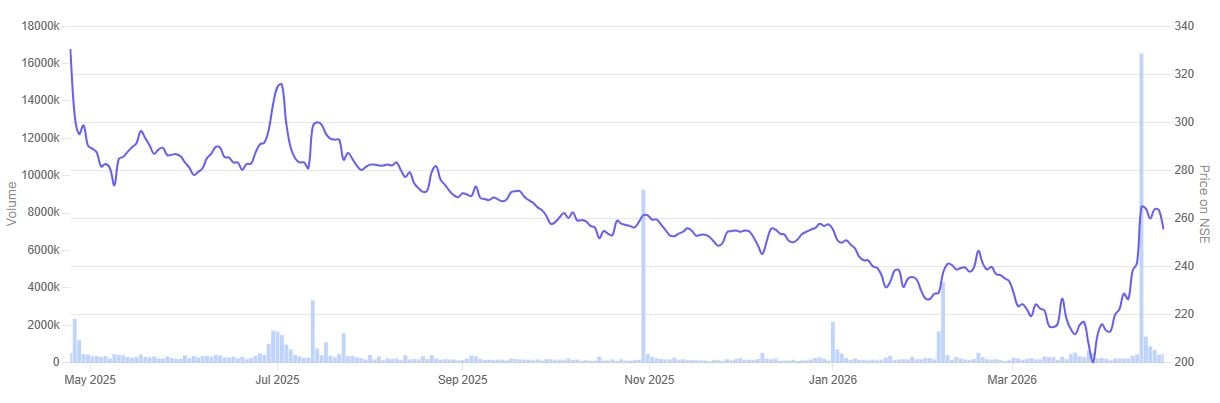
In the past year, the share price of VST Industries tumbled 22%.
VST Industries 1 Year Share Price Chart
#2 Advani Hotels and Resorts (India): The Debt-Free Seasonal Compounder
Incorporated in 1987, Advani Hotels and Resorts (India) is in the hosppitality business. Its sole property is the Caravela Beach Resort in Goa.
As of March 2026, Radhakishan Damani holds 4.18% stake of Advani Hotels and Resorts India. This is his shareholding pattern in Advani Hotels and Resorts India for the past eight quarters.
Radhakishan Damani Shareholding Pattern in Advani Hotels and Resorts India (June 2024 – March 2026)
| Jun-24 | Sep-24 | Dec-24 | Mar-25 | Jun-25 | Sep-25 | Dec-25 | Mar-26 |
| 4.18% | 4.18% | 4.18% | 4.18% | 4.18% | 4.18% | 4.18% | 4.18% |
Seasonal Resilience: How Caravela Beach Resort Drives Q3 Revenue
Advani Hotels & Resorts (India) reported a recovery in performance during the December quarter, supported by seasonal strength in the hospitality sector. Revenue for Q3 FY26 stood at Rs 36 crore, compared to Rs 35 crore in the corresponding quarter last year, reflecting marginal YoY growth. Net profit for the quarter came in at Rs 11 crore, broadly in line with Rs 12 crore reported a year ago, indicating stable earnings despite cost pressures.
The improvement follows a weak monsoon quarter, highlighting the seasonal nature of the business. Demand typically picks up in the second half of the year, particularly in leisure-driven destinations like Goa. The company continues to rely on its flagship Caravela Beach Resort, which remains central to its operations. Occupancy and pricing trends during peak months support revenue visibility, while repeat clientele provides some stability to demand.
Debt-Free Discipline: Funding Growth Through Internal Accruals
On the operational front, the company maintains a conservative approach. It remains largely debt-free and continues to fund upgrades through internal accruals. Management has indicated a preference for gradual improvements rather than aggressive expansion. This keeps capital intensity low and supports cash generation over time.
Dividend remains a key highlight.
The company declared an interim dividend of Rs 1.00 per share with a record date of January 30, 2026. This follows earlier payouts of Rs 0.90 and Rs 1.00 per share during FY25, taking the total dividend declared over the past 12 months to Rs 1.90 per share. The company has declared 28 dividends since 2006, indicating a consistent track record of returning cash to shareholders.
On a trailing basis, the dividend yield offered by the company is an attractive 3.5%.
The overall positioning reflects a business that balances cyclical growth with steady payouts. While performance remains linked to tourism demand and seasonality, the consistent dividend track record makes it relevant in portfolios where income generation and reinvestment play a role alongside capital appreciation.
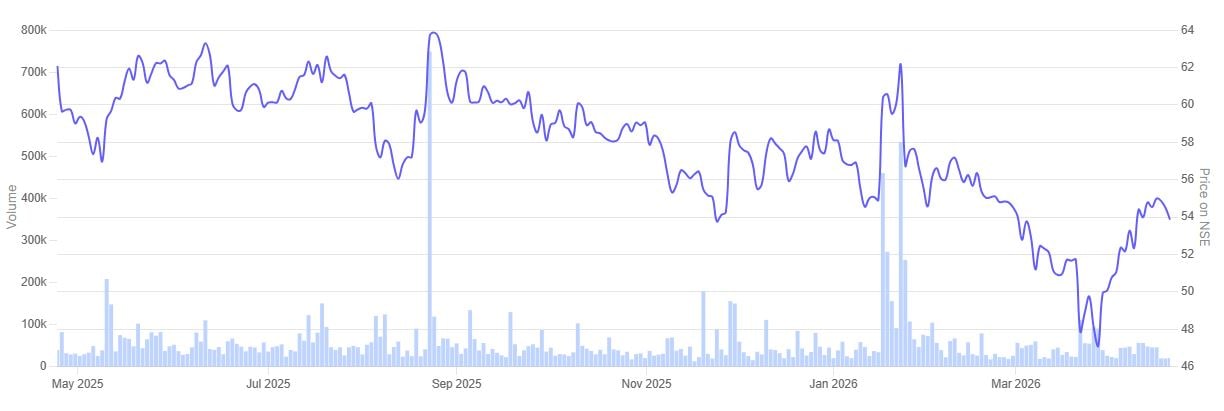
In the past year, the share price of Advani Hotels & Resorts (India) is down 13.1%.
Advani Hotels & Resorts (India) 1 Year Share Price Chart
Relative Value: Why These Gems are Trading Below Historic Averages
Let’s now turn to the valuations of the companies in focus, using the Enterprise Value to EBITDA multiple as a yardstick.
Valuations of Companies in focus
| Sr No | Company | EV/EBITDA Ratio | 5-Year Average EV/EBITDA | Industry Median | ROCE | ROE |
| 1 | VST Industries | 8.8 | 11.9 | 12.5 | 28.2% | 21.1% |
| 2 | Advani Hotels and Resorts India | 13.2 | 14.2 | 14.4 | 45.3% | 34.4% |
In terms of return ratios, both companies are doing well, but the reasons are different.
VST Industries reports a return on capital employed (ROCE) of 28.2% and return on equity (ROE) of 21.1%. Its business runs on steady demand and does not need much capital.
Advani Hotels reports a higher ROCE of 45.3% and ROE of 34.4%. This comes from better use of its assets and stronger performance during good tourism periods.
Valuations for both are below their usual levels. VST Industries is trading at an EV/EBITDA of 8.8, compared to its five-year average of 11.9 and the industry median of 12.5.
Advani Hotels is at 13.2, lower than its five-year average of 14.2 and close to the industry median of 14.4. This shows that prices have not moved up much despite steady numbers.
The businesses are quite different. VST operates in a stable segment, which helps it generate consistent cash and pay regular dividends. Advani Hotels is linked to tourism, so performance depends on seasons and travel demand. Even then, it has managed to keep return ratios strong and continue payouts.
written by Ekta Sonicha of Financial Express


No comments:
Post a Comment