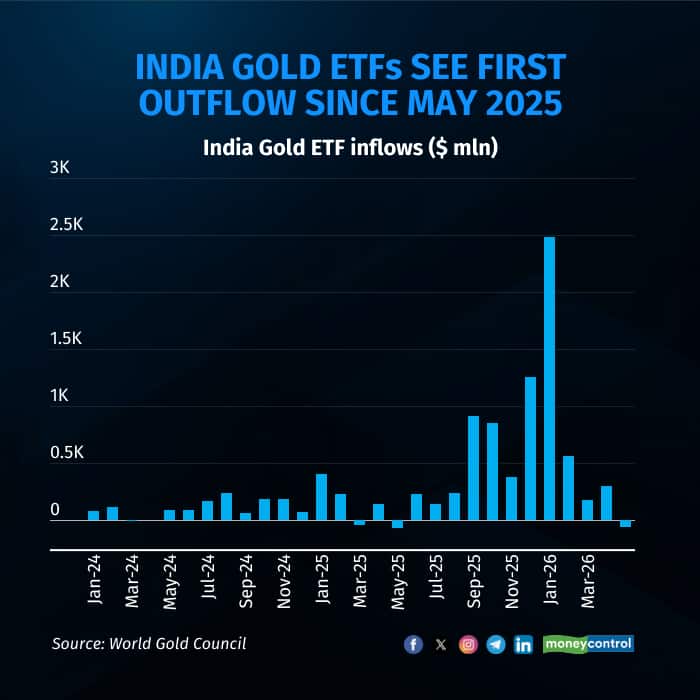
India's gold exchange-traded funds recorded their first net outflow in twelve months in May, as a government decision to raise import duties on the precious metal prompted investors to book profits on the back of rising domestic prices, according to data from the World Gold Council.
Gold ETFs in India saw a net outflow of $61 million in May — the first since May 2025 — a sharp reversal from the $297.2 million inflow recorded in April. The bulk of the month's redemptions came in the wake of the import duty announcement, which pushed domestic gold prices higher and created an opportunity for profit-taking.
The outflow came against a backdrop of sustained price volatility. Gold prices fell for a third consecutive month in May, declining 1.7 percent after a 1.1 percent drop in April and a steep 11.6 percent fall in March.
Among the major funds, Nippon India ETF Gold BeES bore the brunt of the selling, logging outflows of $110 million. Tata Gold Exchange Traded Fund and Kotak Gold ETF followed, with outflows of $28.24 million and $9.2 million respectively, while other gold ETFs saw outflows in the range of $1–6 million. On the other side of the ledger, HSBC Gold ETF attracted the largest inflows at $61.5 million, while ICICI Prudential Gold iWIN ETF and DSP Gold ETF each pulled in $11 million.
Global Gold ETFs See Modest Outflows as Risk Appetite ReturnsThe subdued sentiment in India mirrored a broader pullback in global gold ETF demand. After a notable rebound in April, globally physically backed gold ETFs recorded modest net outflows of $2 billion in May, as rangebound prices and a renewed appetite for riskier assets kept investors largely on the sidelines, the World Gold Council said. Despite the monthly blip, year-to-date flows remained firmly positive, with global gold ETFs accumulating nearly $17 billion so far in 2026.Net outflows pushed global gold ETF assets under management down 2 percent month-on-month to $604 billion, while collective holdings edged 0.4 percent lower to 4,121 tonnes — just shy of the record high of 4,176 tonnes reached on February 27, 2026.North America turned modestly negative, recording outflows of $1.1 billion. Flows have been relatively muted since gold began trading sideways following the sharp March correction, suggesting investors have moved to the sidelines while awaiting a clearer directional catalyst. The opportunity cost of holding gold also rose during the month, weighed down by dollar strength, elevated interest rates, and recalibrated expectations for the Federal Reserve's rate path. Inflation concerns tied to the US-Iran conflict added a further layer of uncertainty around the rate outlook, with some market commentators warning that the Fed may need to remain restrictive for longer.With several of the consensus macro trades from earlier in the year — including gold — having largely played out in the first quarter, investors who had missed the upside or needed to keep pace with benchmarks appeared to rotate back into risk-on sectors, particularly technology. Global technology ETFs saw their largest monthly inflow since early 2024, underscoring the breadth of the shift. Markets, for now, appear to be paying little heed to the risk of a prolonged conflict in the Middle East. Investors are likely to remain patient until risk-on momentum fades or a broader risk-off unwind prompts renewed safe-haven demand, the World Gold Council noted.Europe stood out as the sole region to register inflows, adding $334 million. Positive flows from the United Kingdom and Germany more than offset weakness elsewhere on the continent. In the UK, safe-haven demand was underpinned by political uncertainty and concerns over the government's fiscal position, while a dip in gilt yields in the latter half of the month — aided by softer inflation data and falling oil prices — reduced the opportunity cost of holding gold and encouraged local ETF buying. A similar dynamic played out in Germany, where lower oil prices eased concerns about future European Central Bank tightening, pulling Bund yields lower and supporting demand. Foreign exchange-hedged products, concentrated largely in Switzerland, bucked the trend and recorded outflows as local currencies strengthened against the dollar.Asian funds recorded their first monthly outflow since August 2025, shedding $1.2 billion. The decline was driven almost entirely by China, where a weaker local gold price, an appreciating renminbi, and sustained investor optimism toward domestic equities weighed heavily on gold ETF demand.Source: money control, Network18


No comments:
Post a Comment