

Renewable energy is no longer a distant theme. It has become central to how countries think about power, industry and energy security. As electricity demand rises, clean energy is becoming important for both growth and sustainability.
India is also moving fast in this direction. The government has been pushing renewable capacity, solar manufacturing, green energy corridors and domestic clean-energy supply chains. This has created opportunities for companies across solar, wind, EPC, equipment and allied renewable businesses.
In this article, we look at renewable energy stocks that are growing fast, but are also showing signs of financial discipline. The idea is not to look only at sales growth. The focus is on companies that combine growth with returns, cash generation and promoter commitment.
For this, we first ran a Screener filter. The filter included companies with market capitalisation above Rs 1,000 crore, 3-year sales growth above 15%, RoCE above 12%, debt-to-equity below 2, positive net profit margin in the preceding year, positive operating cash flow over three years, and promoter holding above 50%.
This gave us 9 renewable-linked companies. Some names from the screen, such as Waaree Renewable Technologies, Emmvee Photovoltaic and Premier Energies, were not considered for the final list because we recently covered them in Beyond Adani: The 3 niche solar equipment stocks compounding sales over 75%. From the remaining universe, we selected the top three companies with stronger Return on Capital Employed (RoCE).
#1 Oriana Power: Balancing Asset Monetization with 39.6% RoCE
Incorporated in 2013, Oriana Power is engaged in two main business verticals: providing of EPC and operations of solar power projects, and offering solar energy solutions on a BOOT (build, own, operate, transfer) basis.
Oriana Power Financial Performance
| Metric | Oriana Power |
| FY26 revenue growth YoY | 83.7% |
| FY26 PAT growth YoY | 59.1% |
| FY26 operating cash flow | Rs 337 crore |
| RoCE | 39.6% |
| RoE | 39.6% |
| EV/EBITDA | 8.7x |
Oriana Power reported a strong FY26, helped by higher execution in renewable energy projects and a wider push across solar, storage and green fuels. Revenue from operations rose 83.7% year-on-year (YoY) to Rs 1,814 crore in FY26. Net profit rose to Rs 252 crore up 59.1%.
The company’s growth was backed by strong project activity. Oriana said it has delivered more than 835 MW of solar projects. It also has over 700 MW of solar capacity under execution and 2,500 MW in the pipeline. The company has acquired or is processing around 4,780 acres of land across India. It also carries a CRISIL rating of A-/Stable.
Diversifying Into BESS: Moving Beyond Pure-Play Solar EPC
The company is also expanding beyond plain solar EPC. It has more than 1,000 MWh of Battery Energy Storage Sytem (BESS) projects under execution and more than 3,000 MWh of BESS capacity in the pipeline. During FY26, it secured its first utility-scale solar plus BESS hybrid project of 100 MW/300 MWh connected at CTU. It also commissioned its first group captive open access project in Rajasthan, which the company says is its first integrated hybrid project combining solar and BESS.
Oriana also made progress in larger and more complex renewable projects. It secured one of the world’s large floating solar installations at Maithon Dam in Jharkhand. It entered Latin America through a solar project at an international airport in Guyana. It also commissioned its first ISTS-connected solar project at Prayagraj, Uttar Pradesh. The company further secured open access grid connectivity across Rajasthan, Haryana and Tamil Nadu.
Another area to watch is green fuels. Oriana signed a 10-year green ammonia purchase agreement with SECI for 60,000 tonnes per annum. The company said the contract value is estimated at around Rs 3,135 crore. It is also working on green fuel projects in states such as Madhya Pradesh, Andhra Pradesh, Maharashtra and Uttar Pradesh.
The company is also using partnerships to scale. It signed a joint development agreement with Actis GP LLP for developing 1 GW of renewable energy assets over two years. Oriana will act as the project development and turnkey partner. It also proposed monetisation of around 238 MW of operational solar assets to an Actis group entity at an enterprise value of around $108 million. This asset recycling is expected to support future growth capital.
The financial quality remains central to the stock’s inclusion in this screen. Oriana had positive operating cash flow of Rs 337 crore in FY26, compared with Rs 290 crore in FY25. Return on capital employed (RoCE) stood at 39.6%, while return on equity (RoE) was also at 39.6%. The stock trades at an EV/EBITDA of 8.7 times, compared with its one-year average of 13.7 times. Promoter holding stood at 57.98% as of March 2026.
The Working Capital Headwind: Managing High Debtor Days
The main risk is working capital. Debtor days improved from 146 days in FY25 to 135 days in FY26, but they remain high. The cash conversion cycle stood at 89 days. This means collections will remain important as execution scales up.
For now, Oriana Power fits the article’s quality-growth filter. It combines strong sales growth, high return ratios and positive operating cash flow. The next test will be execution. The company will need to convert its solar, BESS and green fuel pipeline into projects without stretching working capital too much.
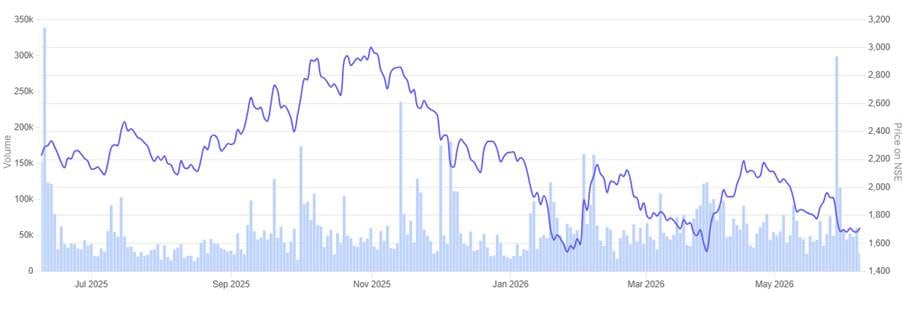
In the past year, the share price of Oriana Power is down 19.5%.
Oriana Power 1 Year Share Price Chart
#2 Waaree Energies: Decoupling a Rs 53,000Cr Order Book From Global Tariff Risks
Incorporated in December 1990, Waaree Energies is an Indian manufacturer of solar PV modules with an aggregate installed capacity of 12 GW. It has five solar module manufacturing facilities in India, with international presence.
Waaree Energies Financial Performance
| Metric | Waaree Energies |
| FY26 revenue growth YoY | 83.7% |
| FY26 PAT growth YoY | 101% |
| FY26 operating cash flow | Rs 1,627 crore |
| RoCE | 38.8% |
| RoE | 32.8% |
| EV/EBITDA | 12.7x |
Waaree Energies reported a strong FY26, helped by higher module sales, better margins and a larger order book. Revenue from operations rose 84% YoY to Rs 26,537 crore. Net profit doubled to Rs 3,884 crore, up 101% from the previous year.
The company’s scale remains a key part of the story. Waaree said its module manufacturing capacity now stands at around 26 GW. It also has 5.4 GW of operational cell manufacturing capacity. During FY26, module production reached 12.6 GW, while module sales stood at nearly 12 GW.
Order Book Visibility: De-Risking Sales via 65% International Orders
Growth visibility also remains strong. The company said its order book was around Rs 53,000 crore, compared with Rs 47,000 crore at the end of Q4 FY25. The order book does not include the retail business, which contributes around 20% of revenue. Overseas orders form nearly 65-70% of the total order book and are expected to be delivered over the next three to four years.
Waaree is also expanding beyond modules. It has planned capex of about Rs 30,000 crore across verticals. The company has started construction of a 10 GW ingot-wafer facility at Nagpur. It also commissioned an additional 3 GW module manufacturing capacity at Samakhiali, Kutch. Expansion in batteries, solar cells, ingot wafers, inverters and green hydrogen electrolysers is progressing as per schedule.
The company is also building a wider energy-transition platform. It plans 20 GWh of battery energy storage capacity, including 3.5 GWh in the current financial year and 16.5 GWh by the next year. It is also setting up 4 GW inverter capacity, 20,000 MVA transformer capacity, 2,500 TPD PV glass capacity and 1 GW green hydrogen electrolyser capacity. This marks its move from a solar module maker to a broader clean-energy manufacturing player.
Waaree is also working on global diversification. Its 1.6 GW US manufacturing facility has already ramped up. The company expects to expand US capacity to 4.2 GW over the next six months. Management said this should help it serve the US market through local capacity and reduce exposure to tariff-related risks.
The return profile also supports its inclusion in the quality-growth screen. RoCE stood at 38.8%, while RoE was 32.8%. The stock trades at an EV/EBITDA of 12.7 times, compared with its one-year average of 18.2 times. The company has also maintained debt-to-equity below one despite heavy capex cycles, according to management. Promoter holding stood at 64.19% as of March 2026.
The Inventory Drag: Evaluating Weaker Operating Cash Conversion
The main area to watch is cash conversion. Cash from operating activity was positive at Rs 1,627 crore in FY26. But it declined from Rs 3,158 crore in FY25. Cash flow from operations to operating profit also fell to 47%. Management attributed weaker cash conversion partly to inventory build-up due to logistics delays and export shipment issues.
For now, Waaree Energies fits the quality-growth filter. It has strong sales growth, high return ratios, positive operating cash flow and a large order book. The next test will be execution. The company will need to complete its large capex programme, protect margins and improve cash conversion as it moves deeper into cells, wafers, storage, glass and other energy-transition businesses.
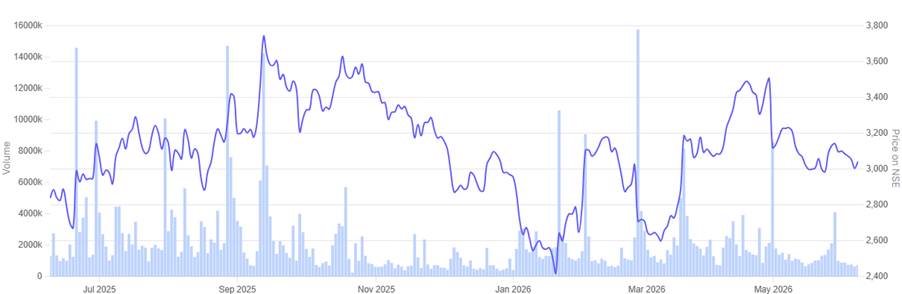
In the past year, the share price of Waaree Energies is up 7.2%.
Waaree Energies 1 Year Share Price Chart
#3 Fujiyama Power Systems: Aggressive Tier-2 Penetration vs Negative Cash Flows
Founded in 2017, Fujiyama Power Systems manufactures products and provides solutions in the rooftop solar industry, including on-grid, off-grid, and hybrid solar systems.
Fujiyama Power Systems Financial Performance
| Metric | Fujiyama Power Systems |
| FY26 revenue growth YoY | 72.3% |
| FY26 PAT growth YoY | 94.6% |
| FY26 operating cash flow | Rs -3 crore |
| RoCE | 35% |
| RoE | 36.4% |
| EV/EBITDA | 20.6x |
Fujiyama Power Systems reported a strong FY26, helped by higher sales in rooftop solar products and wider distribution reach. Revenue from operations rose to Rs 2,655 crore, up 72.3% YoY. Net profit increased to Rs 304 crore up about 94.6%.
The company operates in rooftop solar, with a focus on off-grid and hybrid solar solutions. Management said its products are mainly used as backup systems in areas with inconsistent grid supply. This gives the company a stronger presence in Tier 2 and Tier 3 markets, where solar is often seen as a necessity rather than only an investment product.
Fujiyama also expanded its distribution network during the year. It added more than 80 distributors, over 450 dealers and 30 exclusive Shoppe outlets during the quarter. Its total channel partner network crossed 8,900 as of March 2026. Management said this has helped it deepen its presence in existing markets and enter new regions.
Ratlam Capacity Expansion: Setting Up for Peak Revenue Scaling
The company also made progress on capacity expansion. It commissioned a 2,000 MW solar panel manufacturing facility at Ratlam. Management said the Ratlam facility can generate peak revenue of around Rs 5,000 crore once all lines are fully operational and utilised. The facility is expected to ramp up through FY27 and reach higher utilisation by FY28.
Fujiyama is also strengthening backward integration. It is setting up a 1,200 MW TOPCon solar cell manufacturing facility at Ratlam. Management said this is important for meeting ALMM 2 requirements and for supporting the rooftop solar business. The company also said cell manufacturing will mainly help margins, as it is a backward integration step rather than a direct revenue addition.
The company’s product mix is broader than just panels. It sells solar panels, power electronics and batteries. In Q4, management broadly indicated a 40:40:20 revenue mix between solar panels, electronics and batteries. It also said power electronics and lithium battery capacity expanded during the year.
Fujiyama fits the quality-growth screen on return ratios and promoter ownership. RoCE stood at 35%, while RoE was 36.4%. Promoter holding stood at 86.76% as of March 2026The stock trades at an EV/EBITDA of 20.6 times, compared with its one-year average EV/EBITDA of 27.2 times.
Cash Flow Vulnerabilities: Navigating a 180-Day Inventory Cycle
The main weakness is cash flow. Operating cash flow was slightly negative at Rs 3 crore in FY26. Free cash flow was also negative due to heavy investing activity. Inventory days rose to 180 days. Management said inventory increased mainly due to raw material stocking, new locations and capacity expansion.
For now, Fujiyama Power Systems fits the renewable quality-growth theme better than a general engineering supplier. It has strong sales growth, high return ratios and high promoter holding. But the cash-flow picture is weaker than the headline profit growth. The next test will be whether the company can scale Ratlam, improve working capital and convert growth into stronger operating cash flow.
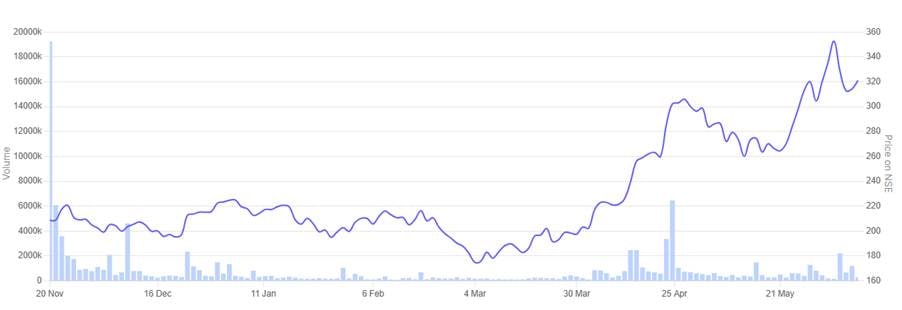
In the past year, the share price of Fujiyama Power Systems rallied 54.4%.
Fujiyama Power Systems 1 Year Share Price Chart
Conclusion
The renewable energy story is not just about fast growth anymore. Many companies are growing because the sector itself is expanding. The real question is whether they can grow without stretching debt, cash flows or working capital too much.
These three companies stand out because they have shown strong FY26 growth and healthy return ratios. They also have high promoter holding, which was one of the key filters used for the screen.
Still, this is not a risk-free theme. Capex plans, inventory levels, project execution and cash conversion will matter from here. In a sector where demand is strong, the better companies will be the ones that turn growth into real cash and steady returns.
Renewable Stocks: Growth vs Returns vs Valuation
| Metric | Oriana Power | Waaree Energies | Fujiyama Power Systems |
| FY26 revenue growth | 83.7% | 83.7% | 72.3% |
| FY26 profit growth | 59.1% | 101.0% | 94.6% |
| FY26 operating cash flow | Rs 337 cr | Rs 1,627 cr | -Rs 3 cr |
| RoCE | 39.6% | 38.8% | 35.0% |
| RoE | 39.6% | 32.8% | 36.4% |
| Promoter holding | 57.98% | 64.19% | 86.76% |
| EV/EBITDA | 8.7x | 12.7x | 20.6x |
| Key theme | Solar, BESS and green fuels | Integrated solar manufacturing | Rooftop solar and power systems |
Source: Q4 FY26 earnings call transcripts, investor updates, Screener.in.
The table shows that while all three companies have delivered strong growth and high return ratios, cash conversion and valuation remain the key differentiators.
click on blues for more information
Source: FinancialExpress


No comments:
Post a Comment