

The Nifty 50 started the week on a negative note, falling 1 percent to close at a two-month low and extending its downtrend for another session on June 8. Bearish sentiment strengthened further, with the index closing below the lower Bollinger Band and all key moving averages trending downward, while momentum indicators also weakened. According to experts, the Nifty 50 is expected to remain range-bound, with the 23,000 level acting as immediate key support. A fall below this level could drag the index towards 22,700. On the upside, 23,300 is likely to serve as the immediate resistance, and a convincing move above it could open the door to the 23,500-23,600 zone.
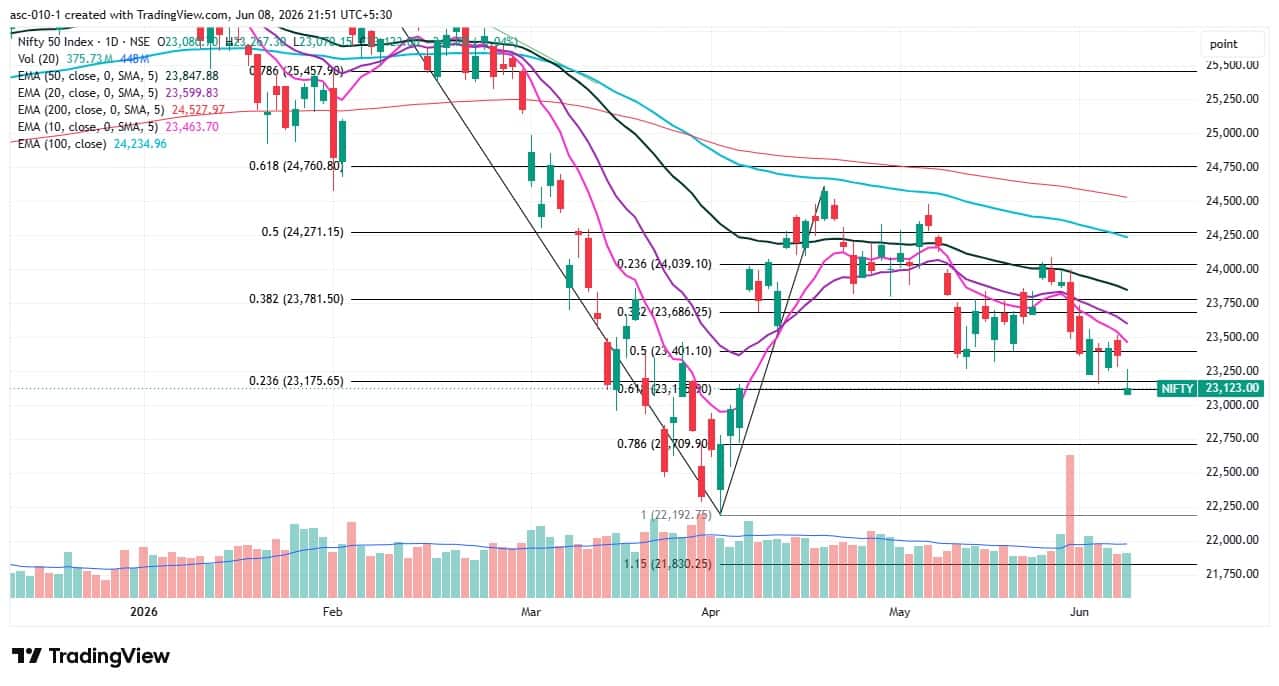
1) Key Levels For The Nifty50 (23,123)
Resistance based on pivot points: 23,229, 23,275, and 23,351
Support based on pivot points: 23,078, 23,032, and 22,956
Special Formation: The Nifty 50 formed a small-bodied bullish candle with a long upper shadow on the daily timeframe after a gap-down opening, indicating pressure at higher levels. The index remained well below all key moving averages, which continued to trend downward, while it hovered near the lower end of the bullish gap formed on April 8. The RSI dropped below the 40 mark to 35.77, while the MACD remained below the signal line, accompanied by a further expansion in the red histogram bars. All these factors indicate that bearish momentum remains intact and the market continues to face selling pressure at higher levels.
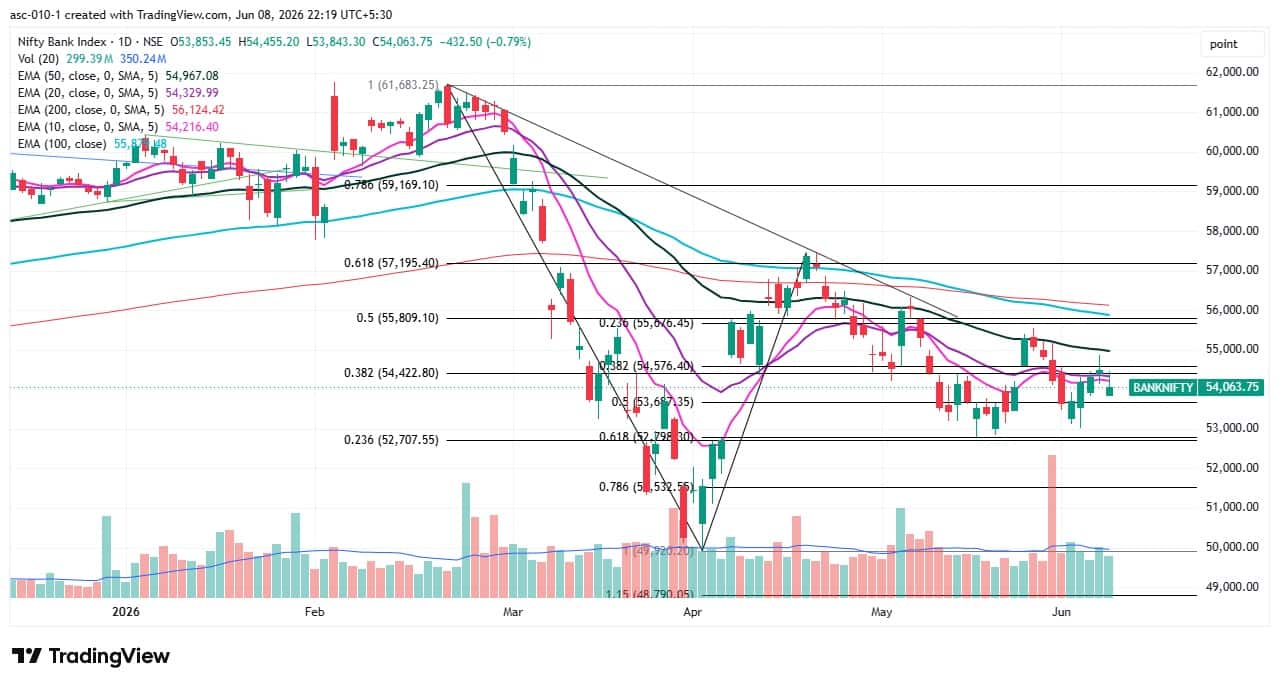
2) Key Levels For The NiftyBank (54,064)
Resistance based on pivot points: 54,355, 54,499, and 54,733
Support based on pivot points: 53,887, 53,743, and 53,509
Resistance based on Fibonacci retracement: 54,423, 55,809
Support based on Fibonacci retracement: 53,687, 52,798
Special Formation: The Nifty Bank snapped its four-day winning streak and closed 0.8 percent lower on Monday, forming a bullish candle with a long upper wick on the daily timeframe, signalling pressure at higher levels. The index slipped below its short-term moving averages and the 38.2 percent Fibonacci retracement level of the correction from the February high to the April low. The RSI stood at 46.6 and is on the verge of a negative crossover, while the MACD remained above the reference line despite fading green histogram bars. All these factors indicate that bullish momentum is weakening and profit-booking pressure may persist in the near term.
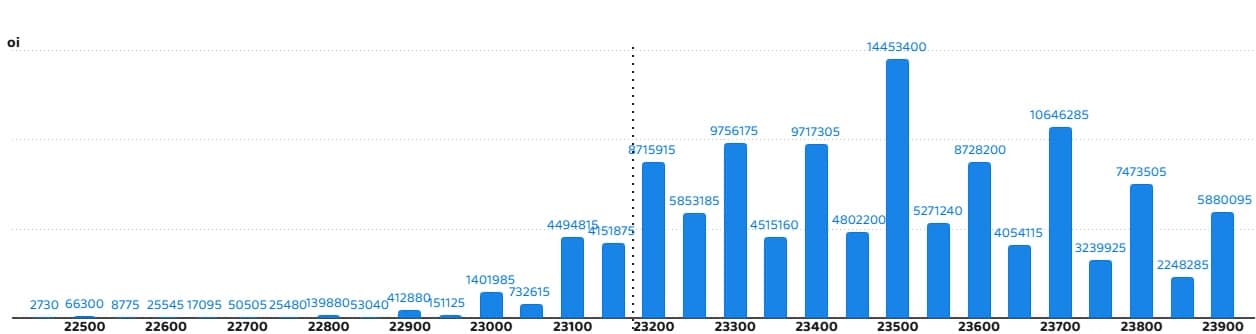
3) Nifty CallOptions Data:
According to the weekly options data, the 23,500 strike holds the maximum Call open interest (with 1.44 crore contracts). This level can act as a key resistance level for the Nifty in the short term. It was followed by the 23,700 strike (1.06 crore contracts) and 23,300 strike (97.56 lakh contracts).
Maximum Call writing was observed at the 23,200 strike, which saw an addition of 72.79 lakh contracts, followed by the 23,300 and 23,250 strikes, which added 52.91 lakh and 52.37 lakh contracts, respectively. The maximum Call unwinding was seen at the 23,850 strike, which shed 2.67 lakh contracts, followed by the 22,500 and 23,900 strikes, which shed 97,760 and 75,010 contracts, respectively.
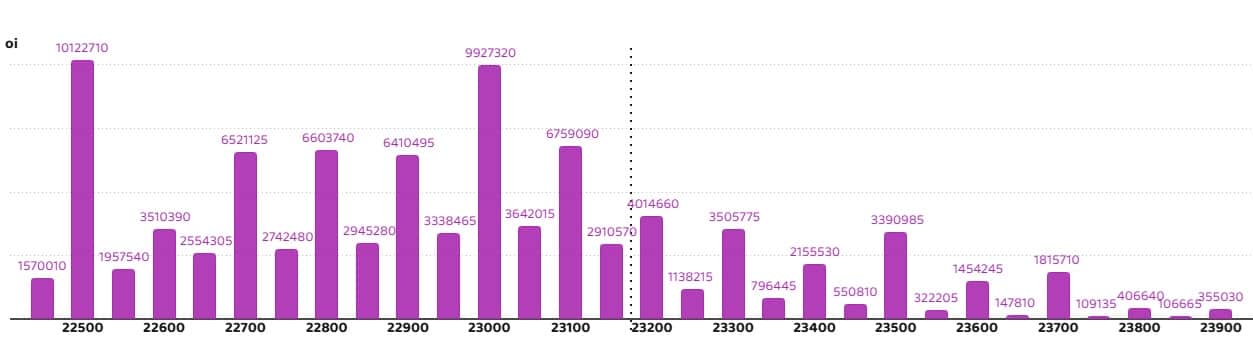
4) Nifty PutOptions Data:
On the Put side, the maximum Put open interest was seen at the 22,500 strike (with 1.01 crore contracts), which can act as a key support level for the Nifty in the short term. It was followed by the 23,000 strike (99.27 lakh contracts) and the 23,100 strike (67.59 lakh contracts).
The maximum Put writing was placed at the 23,100 strike, which saw an addition of 29.73 lakh contracts, followed by the 22,800 and 22,950 strikes, which added 17.82 lakh and 17.24 lakh contracts, respectively. The maximum Put unwinding was seen at the 23,300 strike, which shed 38.85 lakh contracts, followed by the 23,400 and 23,350 strikes, which shed 34.97 lakh and 20.73 lakh contracts, respectively.
5) NiftyBank CallOptions Data:
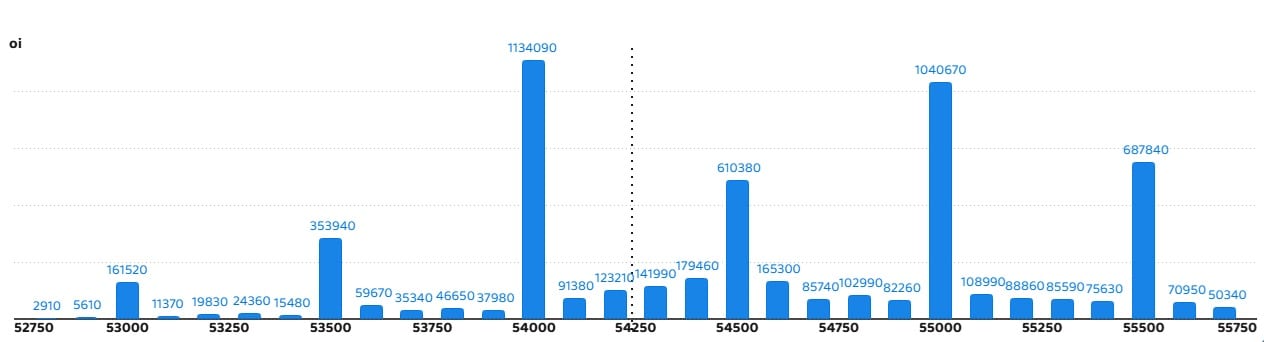
According to the monthly options data, the 54,000 strike holds the maximum Call open interest, with 11.34 lakh contracts. This can act as a key level for the index in the short term. It was followed by the 55,000 strike (10.4 lakh contracts) and the 55,500 strike (6.87 lakh contracts).
Maximum Call writing was observed at the 54,500 strike (with the addition of 85,110 contracts), followed by the 54,300 strike (66,990 contracts) and 54,200 strike (65,070 contracts). The maximum Call unwinding was seen at the 55,500 strike, which shed 18,030 contracts, followed by the 55,300 and 55,400 strikes, which shed 5,820 and 4,260 contracts, respectively.
6) NiftyBank PutOptions Data:
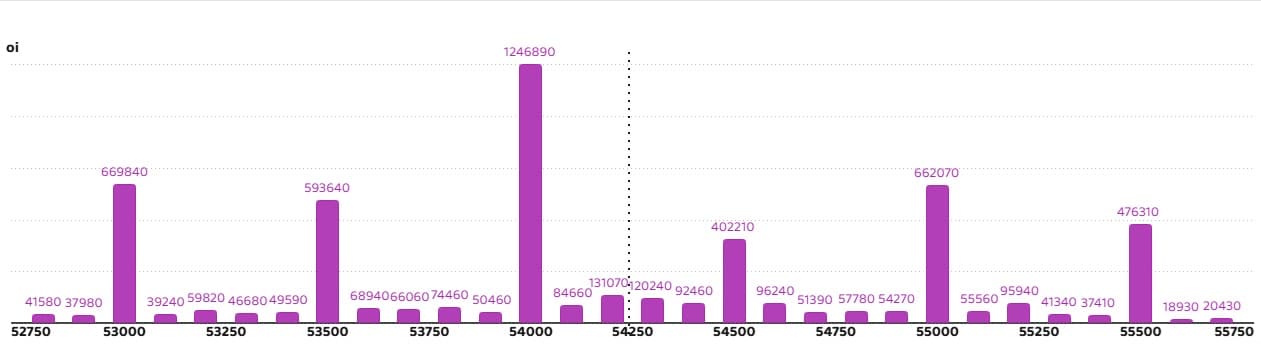
On the Put side, the maximum Put open interest was seen at the 54,000 strike (with 12.46 lakh contracts), which can act as a key support level for the index in the short term. This was followed by the 53,000 strike (6.69 lakh contracts) and the 55,000 strike (6.62 lakh contracts).
The maximum Put writing was placed at the 55,200 strike (which added 40,080 contracts), followed by the 54,200 strike (35,010 contracts) and 54,300 strike (23,640 contracts). The maximum Put unwinding was seen at the 54,000 strike, which shed 19,500 contracts, followed by the 55,000 and 53,400 strikes, which shed 8,250 and 7,710 contracts, respectively.
8) Put-Call Ratio:
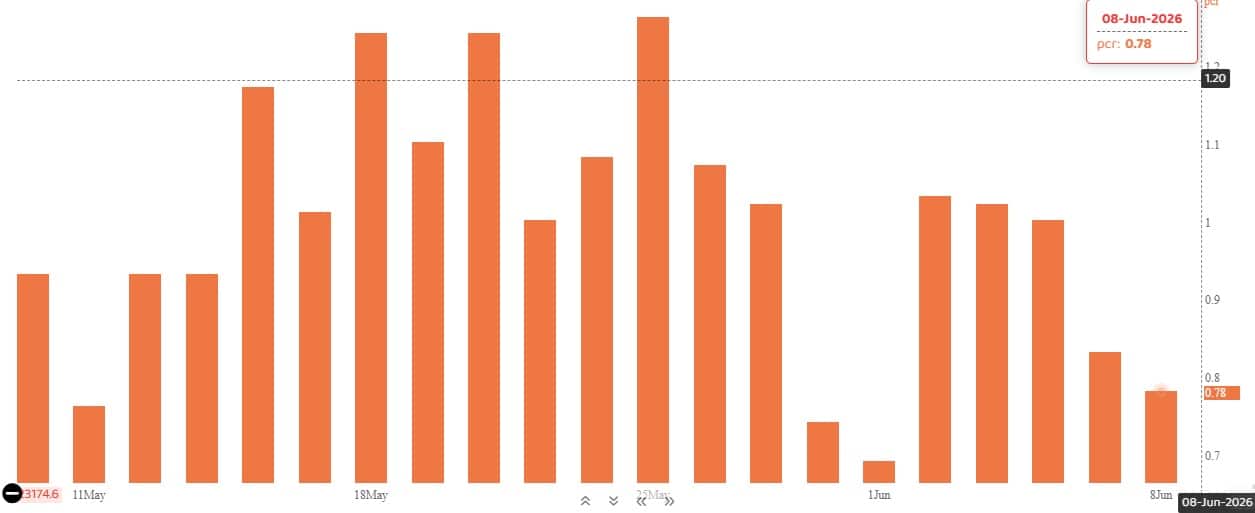
The Nifty Put-Call ratio (PCR), which indicates the mood of the market, slipped to 0.78 on June 8, from 0.83 compared to previous session.
The increasing PCR, or being higher than 0.7 or surpassing 1, means traders are selling more Put options than Call options, which generally indicates the firming up of a bullish sentiment in the market. If the ratio falls below 0.7 or moves towards 0.5, then it indicates selling in Calls is higher than selling in Puts, reflecting a bearish mood in the market.
9) India VIX:
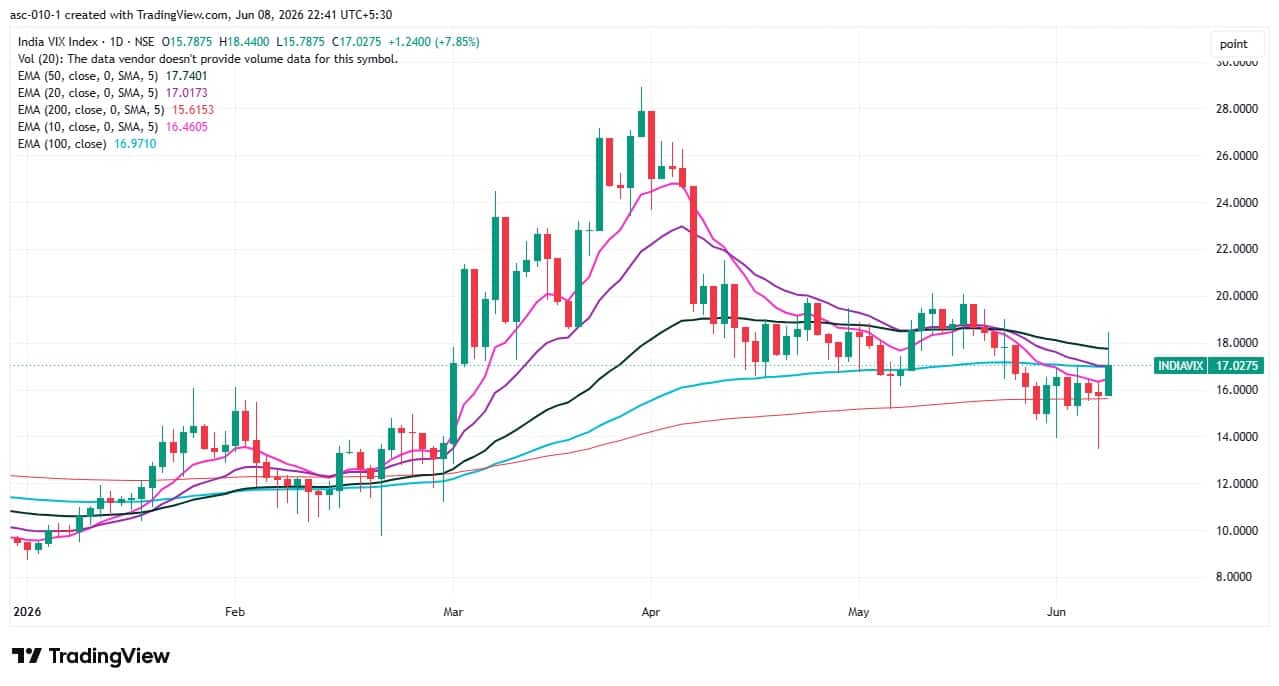
India VIX, the fear gauge, spiked 7.85 percent to 17.03, signalling discomfort among bulls. Any decisive move above the 18 level could trigger heightened caution in the market and lead to increased volatility.
Report by Sunil Shankar Matkar
Source:Network18


No comments:
Post a Comment