


The market ended higher with more than half a percent gains amid volatility but traded within previous week's range for the week ended July 17, backed by encouraging Q1FY27 business updates and growing confidence in a healthy earnings season ahead, with focus decisively shifting from mid and smallcaps to large caps. However, the escalating tensions in West Asia, which lifted crude oil prices above $85 per barrel and pressured the rupee, capped market upside.
In the coming week starting from July 20, the market will first react to quarterly earnings by Reliance Industries, and large private banks (ICICI Bank, HDFC Bank, Axis Bank, and Kotak Mahindra Bank) announced after market hours on Friday and Saturday, and their commentaries, which are expected to shape sectoral performance and define the near-term market narrative.
While, overall, the market will remain volatile and consolidative with a positive bias and focus majorly on further June quarter earnings, and renewed West Asia tensions that impacts oil prices as well as rupee, according to experts.


The Nifty 50 rose 127 points (0.53 percent) to 24,334, and the BSE Sensex soared 582 points (0.75 percent) to 78,151, while the broader markets underperformed the benchmark indices, with the Nifty Midcap and Smallcap 100 indices falling 1 percent and 0.6 percent, respectively.
Indian equities are expected to witness a gradual uptrend next week, on the back of a strong Q1FY27 earnings season so far, which is likely to remain the key driver of sectoral and stock-specific performance," Siddhartha Khemka - Head of Research, Wealth Management at Motilal Oswal Financial Services said.
According to Vinod Nair, Head of Research at Geojit Investments, global investors will closely monitor Japan's inflation data for cues on the future direction of interest rates, while India's PMI releases will offer a timely assessment of economic activity and business confidence.
Furthermore, corrections in select Asian markets amid concerns over elevated AI-driven valuations could improve India's relative attractiveness within the emerging market space, he said.
Meanwhile, Vinod Nair believes India remains well placed to attract long-term capital flows, supported by robust economic fundamentals, healthy domestic demand, and a diversified growth profile.
Here are 10 key factors to watch next week:
1) Q1 Corporate Earnings
The June quarter earnings will be in full swing next week, as more than 250 companies will release their earnings scorecard with focus on key names like Infosys, UltraTech Cement, Bajaj Auto, Dr Reddy's Laboratories, Eternal, Nestle India, Cipla, InterGlobe Aviation, NTPC, SBI Life Insurance Company, Shriram Finance, and Tata Consumer Products which have nearly 14 percent weightage in the Nifty 50.
Further, the focus will also be on results from non-Nifty names like One 97 Communications, Meesho, IndusInd Bank, Bank of Baroda, Bandhan Bank, ACC, CSB Bank, Indian Overseas Bank, Sobha, Aditya Birla Sun Life AMC, Indian Hotels Company, JSW Infrastructure, Mahindra & Mahindra Financial Services, TVS Motor Company, Adani Green Energy, Adani Power, Bharat Petroleum Corporation, Hindustan Petroleum Corporation, JSW Energy, United Spirits, Indian Energy Exchange, Motilal Oswal Financial Services, PVR Inox, Vishal Mega Mart, Jindal Steel, Dr Lal PathLabs, SBI Cards and Payment Services, and IDFC First Bank.
2) West Asia Tensions, and Oil Prices
The oil price factor will remain on market participants' radar next week as tensions in West Asia have escalated after Iran formally suspended its MOU commitments, describing the conflict as an "existential war." Meanwhile, Washington has warned that it could directly target Iranian power infrastructure in the absence of a diplomatic breakthrough.
Brent crude oil futures, the international oil benchmark, posted their biggest weekly gains since April, rising 15.91 percent to $88.10 a barrel after a gap-up opening, in addition to the nearly 6 percent rally witnessed in the previous week.
The continued US strikes on Iranian military infrastructure, particularly after Iran broadened its retaliation by targeting US assets in Bahrain, Jordan, Kuwait, Oman, Qatar, and Syria—resulting in the deaths of two US service members, while another remains missing—weighed on market sentiment. Separately, Tehran has instructed Yemen's Houthi movement to stand ready to close the Bab el-Mandeb Strait, which now carries around 5-7 percent of global energy supplies following the rerouting of Gulf crude through Saudi Arabia's East-West Pipeline, if the US targets Iranian power infrastructure.
Meanwhile, Iran and Syria have signed an agreement to rebuild an oil pipeline that would provide an alternative to the Strait of Hormuz, which carries around 20 percent of the global oil supply. CNBC reported.
Further, Qatar and Pakistan are actively working to bring both sides back to the negotiating table, though the MOU remains suspended and tensions are at their highest level since April. "Any diplomatic signal from Washington or Tehran will move markets far more than any data point. For crude, the dual chokepoint risk keeps the upside bias intact," said Kaynat Chainwala of Kotak Securities.
3) Indian Rupee
The focus will also be on the Indian rupee which depreciated further to close at 96.27 against the US dollar, the lowest ever closing level, weakening by 0.94 percent during the week, as elevated crude oil prices and cautious foreign fund flows continue to weigh on sentiment. The weakness continued for third consecutive week, and the currency pair chart formation suggests the rounding bottom formation is in the making on the weekly charts.
"Market participants will closely monitor global developments, crude oil movement, and FII activity for the next directional move. Technically, the rupee is expected to trade in the 96.00–96.55 range, with the overall trend continuing to favour weakness," Jateen Trivedi, VP Research Analyst - Commodity and Currency at LKP Securities said.
The US dollar index fell 0.21 percent during the week to 100.754, which has been rangebound for last three-four weeks.
4) Global Economic Data
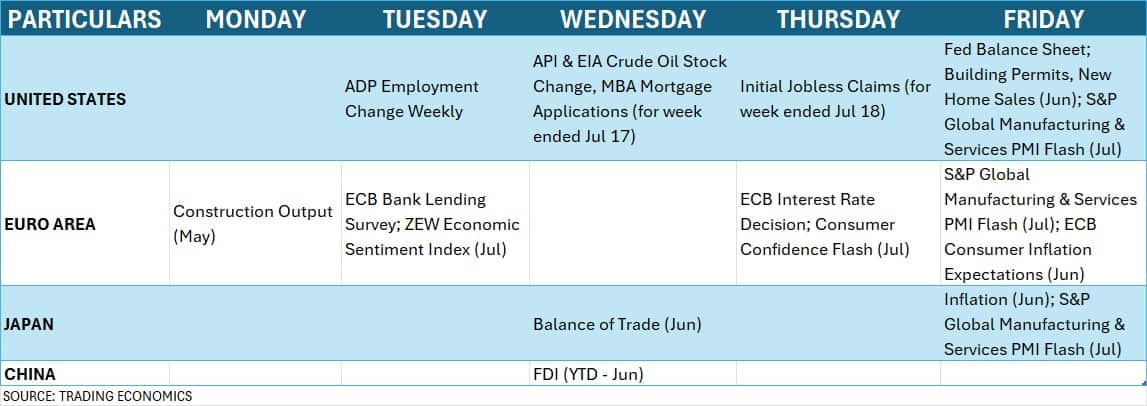
Globally, the week ahead is light on US data, with focus on the preliminary PMI readings, new home sales, and weekly jobs data. The flash PMI readings from Europe and Japan along with Japanese inflation will also be watched.
Global investors will also focus on the European Central Bank's interest rate decision next week, and closely monitor Japan's inflation data for cues on the future direction of interest rates.
Most economists expect the European Central Bank to keep its interest rates unchanged in the policy meeting on July 23.
5) Domestic Economic Data
Back home, the focus will be on the flash PMI data for July releasing on July 24, which will offer a timely assessment of economic activity and business confidence. HSBC Manufacturing PMI dropped to 54.2 in June from 55 in May, and in the same period, Services PMI fell to 57.4 from 58.9.
On the same day, bank loan and deposit growth for fortnight ended July 10, and foreign exchange reserves for week ended July 7 will also be released, while the infrastructure output data for June will be announced on July 20.
6) FII flow:
The mood at the foreign institutional investors' (FIIs) desk will also be closely watched by market participants, as there has been inconsistency in their flows, which may be impacted by the ongoing Middle East tensions, rising oil prices, and the weakening rupee. FIIs were net sellers of more than Rs 9,110 crore worth of shares in the cash segment during the past week, compared with net buying of more than Rs 4,600 crore worth of shares in the previous week. For current month, they have sold more than Rs 4,500 crore worth shares.
On the contrary, domestic institutional investors (DIIs) maintained their buying spree, purchasing shares worth Rs 9,800 crore during the week gone by, taking their net buying for the current month to Rs 21,074 crore.
7) IPO Action
The primary market will have a busy schedule in the coming week with a total of seven new IPOs hitting Dalal Street. In the mainboard segment, Cube Highways and Infrastructure-sponsored Cube Highways Trust InvIT will open its Rs 5,000-crore public issue, which comprises of solely offer-for-sale, on July 22, with price band of Rs 151-152 per unit. Indo-MIM, Lohia Corp, and Xtranet Technologies will launch their IPOs for public subscription on July 23.
In the SME segment, Gulf Lloyds India will open its fixed-price public issue on July 20, while the maiden public issue of Metalic Technoforge, and Shree Balaji Mala Textiles will be opened on July 21 and 22, respectively.
Further, Caliber Mining & Logistics, from the mainboard segment, will close its Rs 450-crore IPO on July 21, while Sotefin Bharat's SME public issue will remain open until July 20.
Additionally, five new companies are scheduled to list on the bourses next week. SBI Funds Management will make its much-awaited market debut on July 21, while Alpine Texworld, and Millworks Technologies shares will also be available for trading on the same day. This will be followed by listing of Sotefin Bharat from the SME segment on July 23 and Caliber Mining & Logistics from the mainboard segment on July 24.
8) Technical View
Technically, the benchmark Nifty 50 bounced back with a bullish candlestick formation and remained above its short-term and long-term moving averages. However, it could not surpass the 50-week EMA (24,380) and the previous week's high (24,530), which are crucial resistance levels. A sustained move above these levels could increase the possibility of a further upward journey toward the 24,800-25,000 zone.
The momentum indicators also remained supportive on a weekly basis. The RSI, at 51.55, maintained a bullish crossover, while the MACD stayed above its signal line, with the green histogram bar continuing to rise. On the downside, support is placed in the 24,000-23,950 zone. A break below this zone could bring the 23,800 level into focus.
9) F&O Cues, India VIX
The weekly options data indicated that, in the near term, the 24,200-24,000 strikes, which have the maximum Put open interest, could act as a support zone for the Nifty 50. However, the 24,300-24,600 strikes, where the maximum Call open interest is concentrated, could act as resistance.
Meanwhile, the India VIX, the fear gauge, extended its uptrend for another week, rising 7.33 percent to 13.15. However, it is not at alarming levels yet and continues to trade below all its key moving averages. Any sustained sharp spike above the 15 zone could cause discomfort for bulls.
10) Corporate Action
Here are key corporate actions taking place in the coming week:
Report by Sunil Sankar Matkar
Source: Network18


No comments:
Post a Comment