
Mutual funds have turned net sellers in Indian equities for the first time in three years, offloading stocks worth around Rs 4,100 crore so far in February. They have been net sellers in six of the seven trading sessions this month.
The last instance of net selling was in April 2023, when mutual funds sold over Rs 4,532 crore in local equities. Prior to this, they had remained net buyers for 34 consecutive months.The shift follows sustained buying in recent periods. MFs purchased equities worth Rs 42,355 crore in January 2026 and accumulated around Rs 4.93 lakh crore in Indian equities during 2025.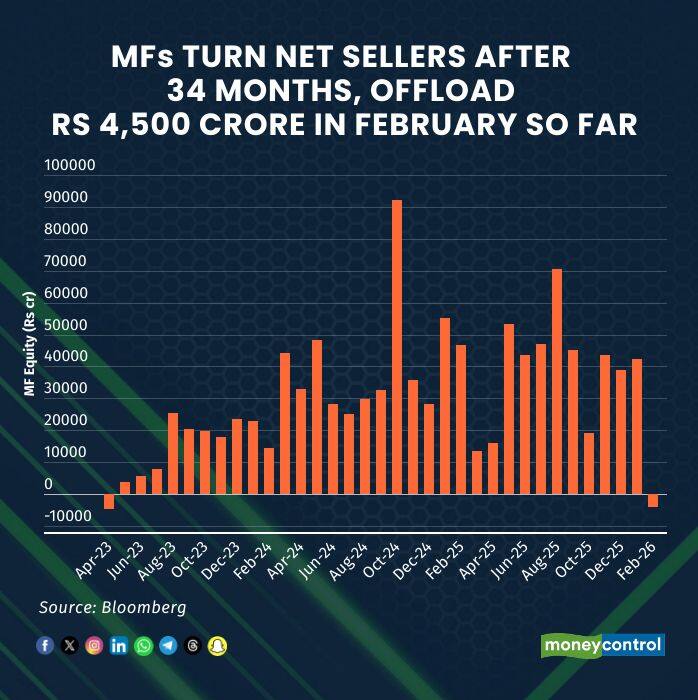 Deven Choksey, Managing Director at DRChoksey FinServ, said the recent selling reflects portfolio repositioning rather than redemption pressure. He noted that funds are exiting some underperforming stocks and reallocating capital to better-quality names, particularly in the large-cap segment.Experts said that some funds are also churning portfolios after accumulating stocks when foreign institutional investors were selling earlier. According to him, there is no indication of redemption pressure at present, with SIP inflows continuing, and the activity appears to be linked to portfolio churn and profit booking.Feroze Azeez, Deputy Chief Executive Officer at Anand Rathi Wealth, said the scale of selling should not be viewed as decisive. In an industry managing around Rs 40 lakh crore, he said, Rs 4,100 crore is relatively small and could reflect actions by a few schemes or asset management companies.Experts added that the selling could also be linked to index rebalancing, noting that January 31 is a review date for NSE indices and that MSCI announced a rejig in early February. They said the key factor to monitor is whether equity fund inflows remain intact, as sustained outflows combined with selling would carry different implications.Akshay Chinchalkar, Managing Partner and Head of Market Strategy at The Wealth Company, said multiple factors may be influencing flows, including evolving details of the India–US trade deal, particularly revisions related to agricultural goods. He added that investors have also shown increased interest in gold and silver ETFs, bond funds and hybrid funds amid geopolitical uncertainty and expectations of further policy easing.The divergence is visible in broader market performance. While the Nifty 500 is down about 3.4 percent from its 52-week high, around 50 percent of stocks in the index are trading more than 20 percent below their respective 52-week highs. Foreign investors have shown interest intermittently, but sustained inflows may depend on relative valuations and currency stability, with the rupee remaining near its lows despite recent policy measures.
Report by Ravindra Sonavane at Network18


No comments:
Post a Comment